Madison Elite
Decks
(608) 555-0100

Deck builders in Madison, Wisconsin

Madison Elite Decks | Custom Deck Builders for Composite & Wood Decks, Deck Replacement, Deck Repair & Screened Porches

Composite, PVC, cedar and treated decks, every one of them on footings dug 48 inches down, below the Wisconsin frost line. We build new, tear out and replace, fix what last winter broke, and screen in the porch so June evenings stay usable.

  • 48 in.Footing depth we dig to, below frost
  • 1 visitTo measure, draw and price your deck
  • PermitPulled and inspections booked for you
  • Dec to MarDesign season, so you build at thaw
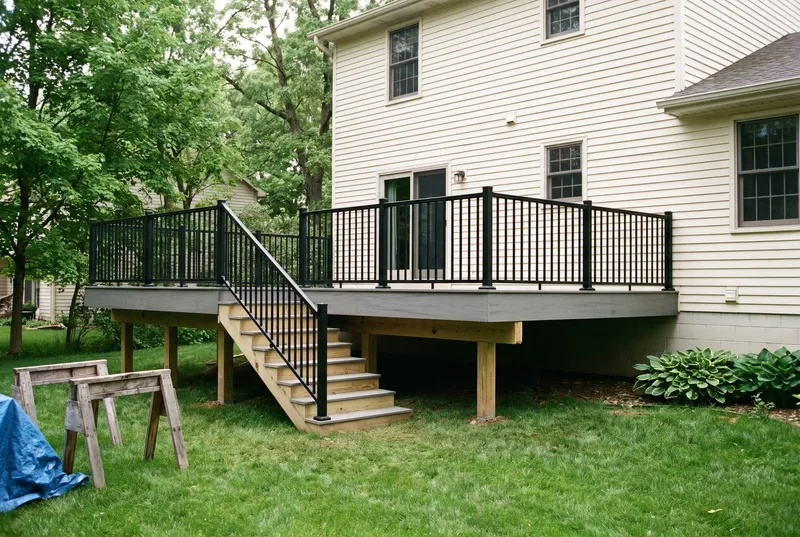
Grey composite deck with black aluminum rail and stairs behind a two-story Madison house

Madison Elite Decks builds capped composite and PVC decks from Trex, TimberTech and AZEK, cedar and pressure-treated decks, screened porches and three season rooms. A deck here is a bit like a dock post in a lake that freezes. What you see matters less than how far down it goes. So every frame starts with footings below the frost line and a ledger that is flashed and through-bolted to the house. Joists sit on 16 inch centers, or 12 where the board maker asks for it, with hidden fasteners on top and aluminum, cable or cedar rail around the edge.

Our Madison deck crew measures on site and sends a scaled drawing with a written quote. We pull the building permit, book the inspections and call in the utility locate before a hole is dug. The season is short. Thaw to late fall gives a crew about 30 working weeks, and the calendar fills from the front. In our opinion the best month to call a deck builder is January. The Madison deck contractors with open dates in June are usually the ones who drew your deck over the winter.

  • Footings dug below the frost line on every deck
  • Scaled drawing and written quote after one visit
  • Building permit and inspections handled
  • Winter design, so your build starts at thaw
  • Composite, PVC, cedar and treated lumber

See the project gallery

Homes

Residential deck building in Madison

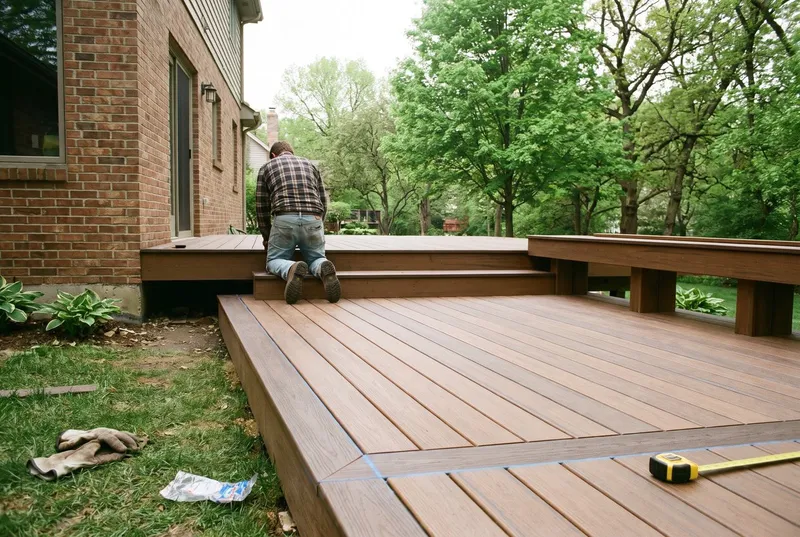
Two-level composite deck with a picture-frame border and a built-in bench

Custom deck design and construction

Multi-level and wraparound layouts, picture-frame borders, two-tone inlays, built-in benches and planters. You get a scaled drawing with the footing layout and the stair position before the quote, so the number matches what gets built. Most custom decks here run 250 to 500 square feet. We think the stairs deserve as much thought as the deck, because they decide how you walk to the yard in July and where the snow gets shovelled in February. Draw them first.

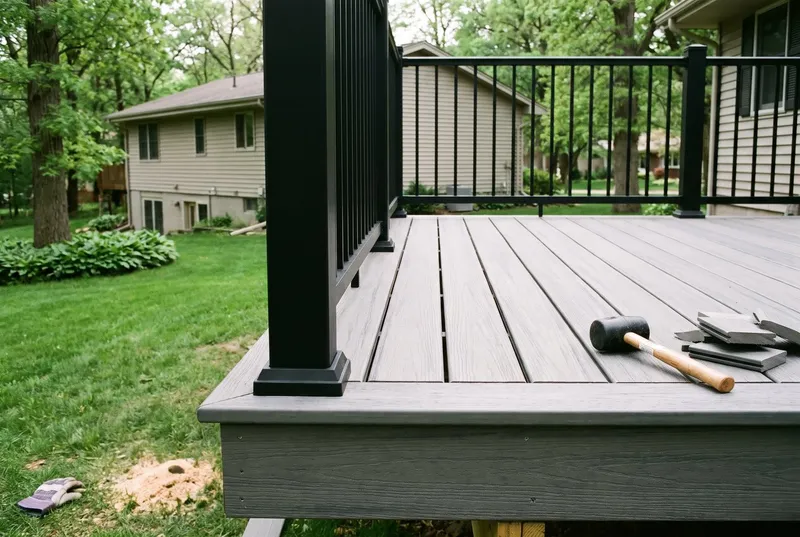
Grey capped composite boards with hidden fasteners and black aluminum rail

Composite deck builders

Trex Transcend and Select, TimberTech Legacy and Terrain, and Fiberon. Capped boards never need stain and carry 25 to 50 year fade and stain warranties from the maker. We frame at 12 inch centers where the board asks for it. Is a composite deck worth the money? Pricey, yes. If you plan to stay ten years we think it pays, because a Wisconsin wood deck wants three or four rounds of washing and stain in that time and a capped board wants a hose. One warning. Dark boards in full sun get hot.

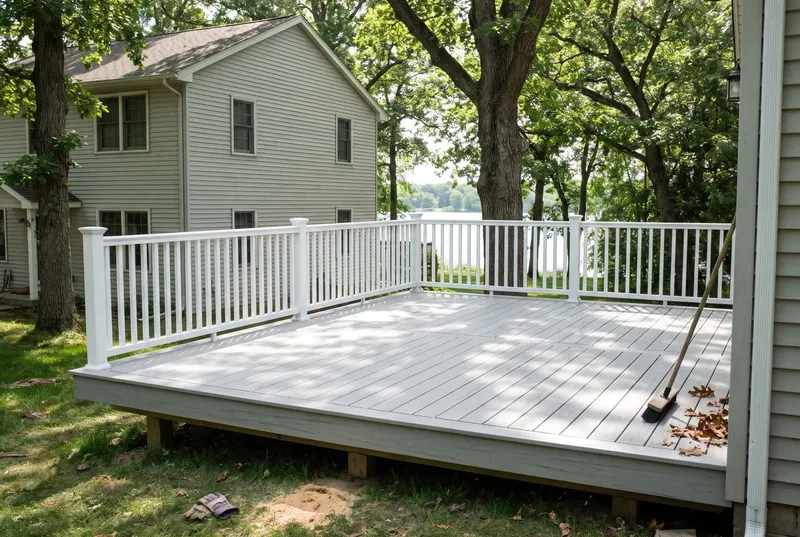
Pale PVC deck with white rail under oaks, a lake through the trees

PVC and low-maintenance decking

TimberTech AZEK and Advanced PVC boards hold no wood fibre, so there is nothing to take on water. That makes PVC our pick for a deck in deep shade, or for a yard that backs onto Mendota, Monona or Wingra, where the air stays damp all summer. Lighter colours run cooler under bare feet. It adds a few dollars a square foot over composite, which in our opinion is money well spent near water and money wasted on a sunny, dry lot.

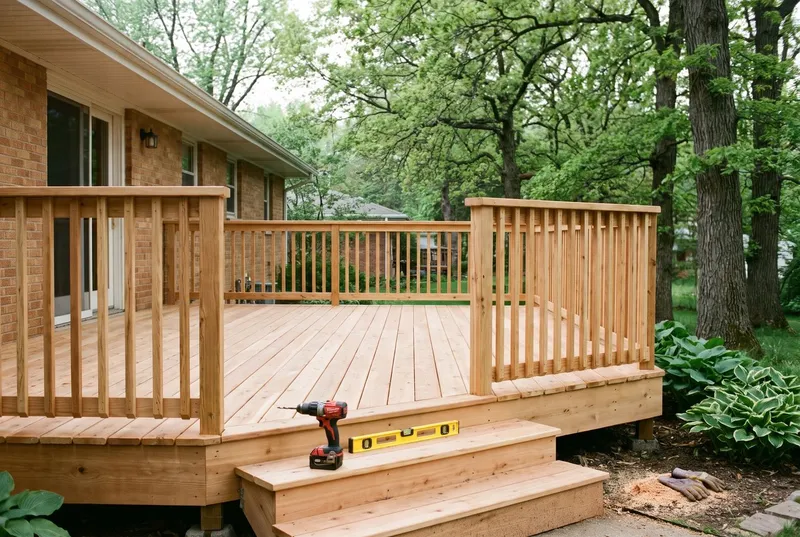
New cedar deck with cedar rail and steps behind a brick ranch

Cedar and pressure-treated wood decks

Western red cedar or northern white cedar on top, ground-contact treated pine underneath, coated or stainless screws. Nothing else smells like a new cedar deck, and for some people that settles it. Be honest with yourself about upkeep, though. New treated lumber needs a few weeks to dry before it takes stain, and a wood deck in Wisconsin wants a wash and a fresh coat every two to three years. Skip two rounds and you will see it. The boards go grey, the ends check, and the wide ones start to cup.

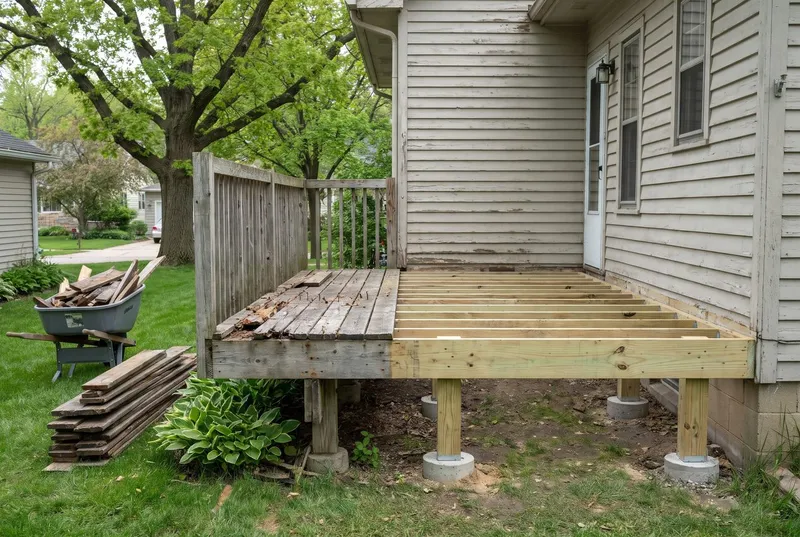
Old weathered deck coming out beside a new treated frame on concrete footings

Deck replacement

We tear out and haul away the old deck, then dig new footings to frost depth. We do not reuse shallow ones, even when they look fine. Plenty of decks around Madison went in on 24 or 30 inch footings, and those are the ones that lean now. The ledger gets new flashing and through-bolts. You can keep the same footprint or go larger while the permit is open, and most replacements take one to two weeks once the old deck is in the dumpster.

Deck repair

Heaved footings, rotted joists and rim boards, loose railings, failed ledger flashing and boards that popped over winter. Most people find the damage in April. The snow goes, and there it is. Repairs are quoted line by line. When more than a third of the frame has gone, we show the replacement price beside the repair price and let you choose. We would rather tell you a $900 fix will do than sell you a new deck you do not need.

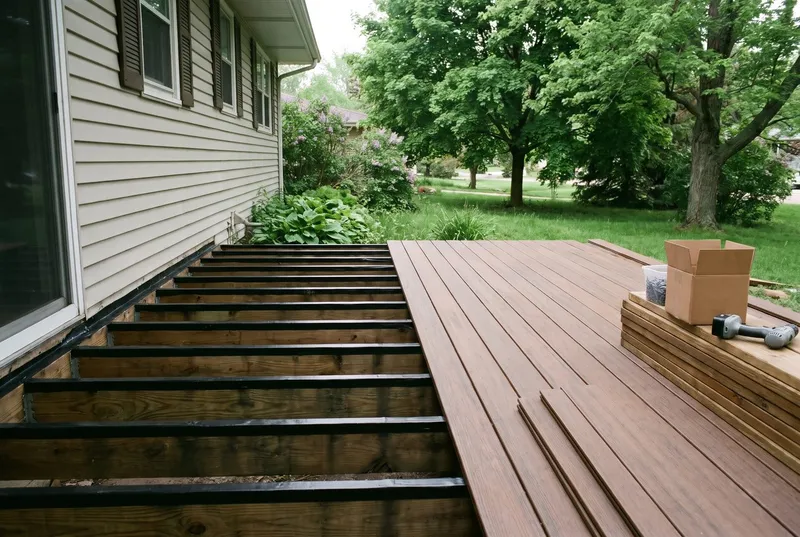
New composite boards going down over taped joists on an older frame

Deck resurfacing

New composite or cedar boards and new rails, on the frame you already have, provided it passes inspection. We tape the tops of the old joists, add blocking where composite needs shorter spans, and swap out any soft lumber we find. Expect half to two thirds of the price of a full rebuild. It only makes sense on a frame under about 15 years old with full-depth footings. Thirty-year boards on a 25-year frame is false economy. We will say so.

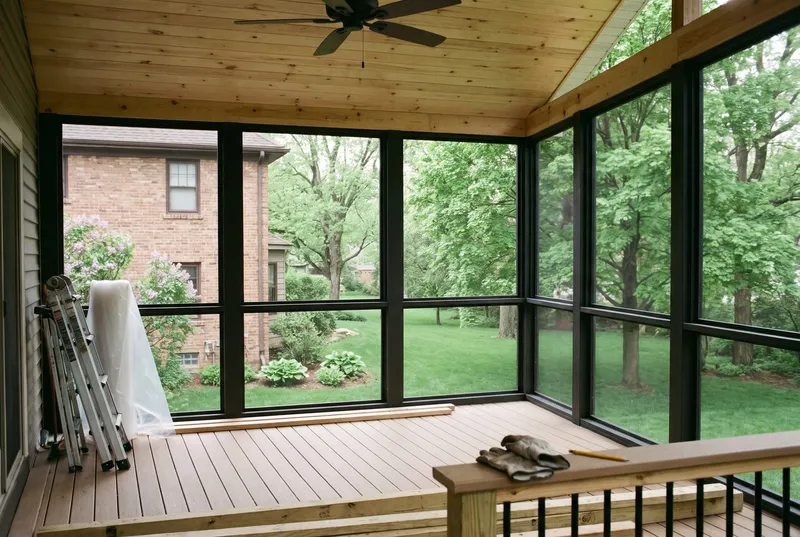
Screened porch on a deck frame with a pine ceiling and a fan

Screened porches and three season rooms

Screened rooms on a new or existing deck frame, with track screen systems and knee walls. Anyone who has tried to eat outside near the lakes in June knows why. A three season room adds vinyl or glass panels for use from April to November. Footings and the roof are sized for Wisconsin snow load, which a plain deck frame is not. People miss that part when they ask us to just add a roof to the deck they already have, and it is usually the reason the answer is new footings.

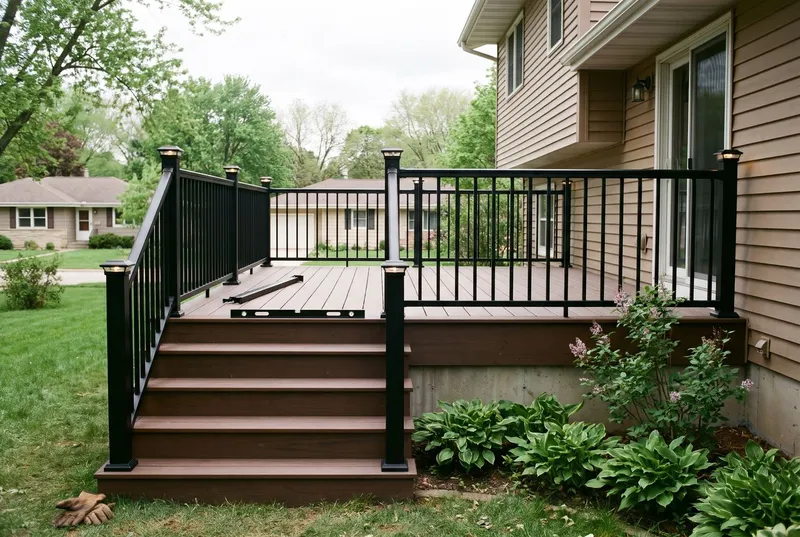
Black aluminum railing and composite stairs with lighted post caps

Deck railings and stairs

Aluminum, cable, glass, composite and cedar railings. Once a deck stands more than 24 inches off the ground it needs a guard, and the guard is built 36 inches high. We cut new stair stringers, fit handrails you can actually grip, and wire lighted posts while the rail is open. Our advice is simple. Sit down before you pick a rail, because a thick top rail lands right at eye level from a chair and cable or glass does not.

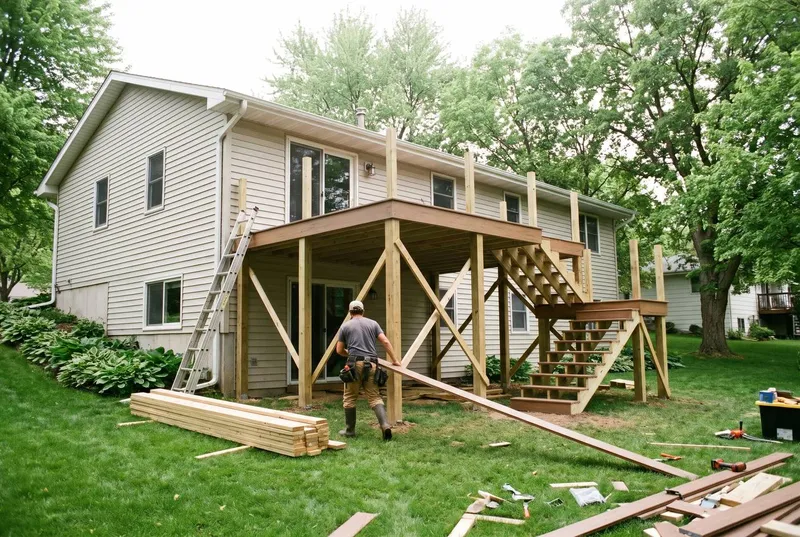
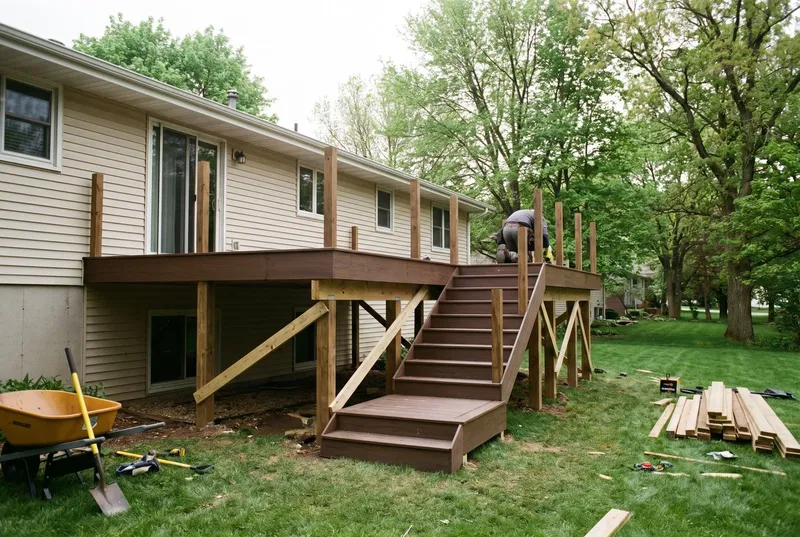
Raised deck on braced 6x6 posts off a walkout ranch, mid-build

Second-story and walkout decks

A lot of Madison ranches sit on a slope with a walkout basement, which puts the deck 8 to 12 feet in the air. Up there it is a small structure, not a platform. Tall 6x6 posts on engineered footings, beams sized from span tables, diagonal bracing, and stairs to the lawn with a landing halfway. In our opinion a drainage ceiling underneath is the best money on the job, since it turns the space below into a dry patio.

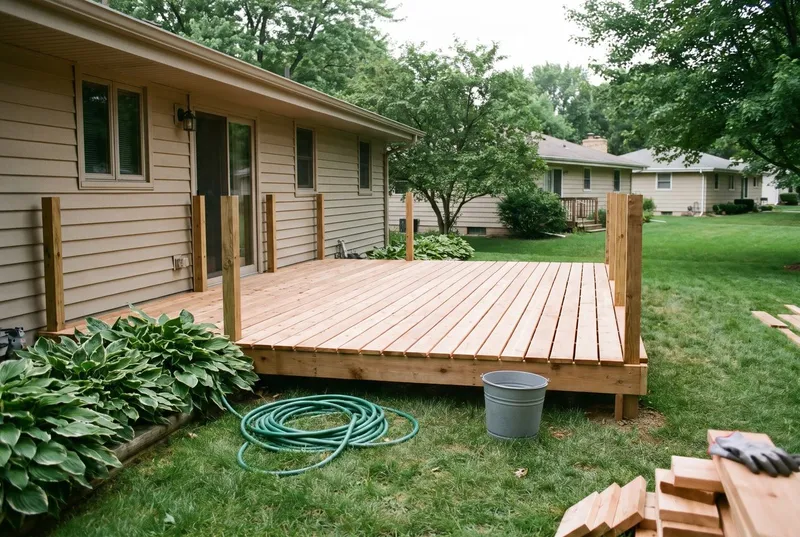
Low cedar platform deck at lawn level behind a ranch house

Ground-level and floating decks

Low does not mean simple. A platform a foot off the grass still has to deal with frost, either on full-depth footings or as a freestanding frame that can rise and settle in one piece. We use ground-contact lumber and leave air under the frame so it can dry out after the thaw. Sometimes a paver patio is the better answer for the money. If it is, we say so.

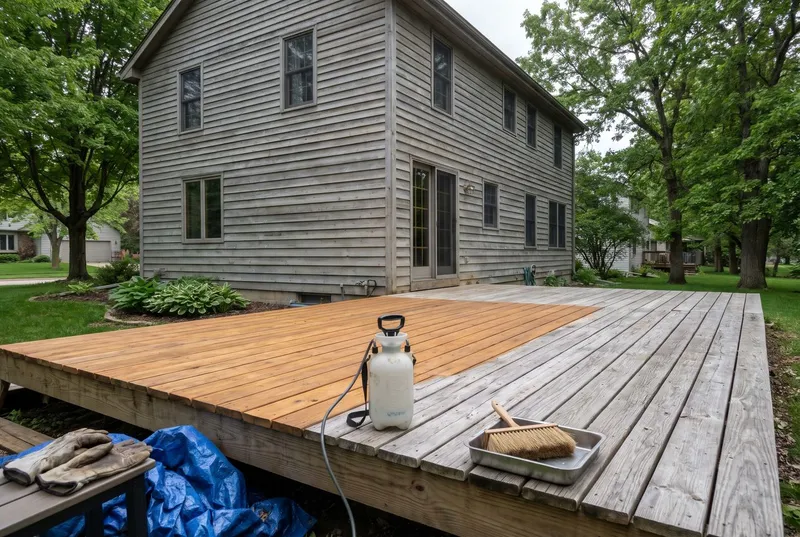
Deck half stained honey brown, half still weathered grey

Deck staining and refinishing

Strip, brighten, sand and stain with an oil-based semi-transparent or solid finish. The window is narrow here, roughly May to September, when the wood is dry and the nights stay above 50 degrees. Cedar and treated pine both want a fresh coat every two to three years. Done on time it is a weekend job. Left four or five years, it is a sanding job first.

Beyond the standard deck

Specialty deck services

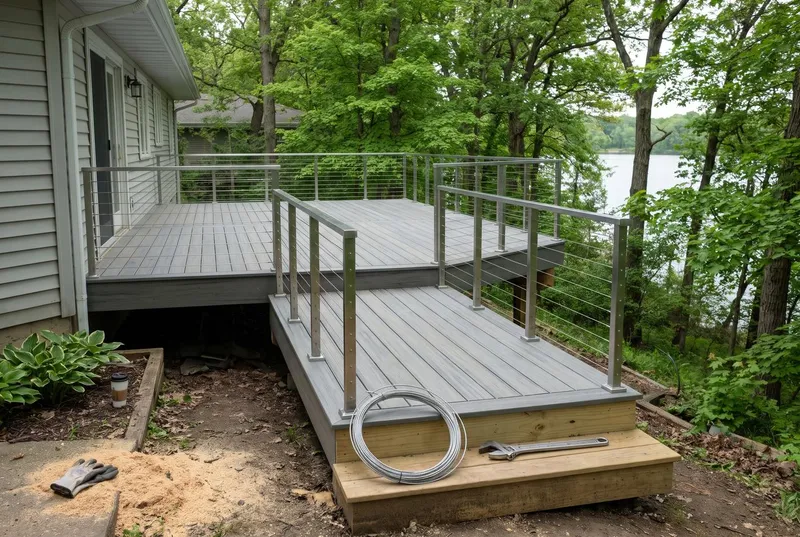
Two-level composite deck with cable rail on a wooded lakeside slope

Lakefront and sloped-lot decks

Stepped frames on a grade, helical piles where digging is not practical, and cable or glass rail to keep the view. Lakeshore lots fall under county shoreland zoning, and we check the setback before we draw.

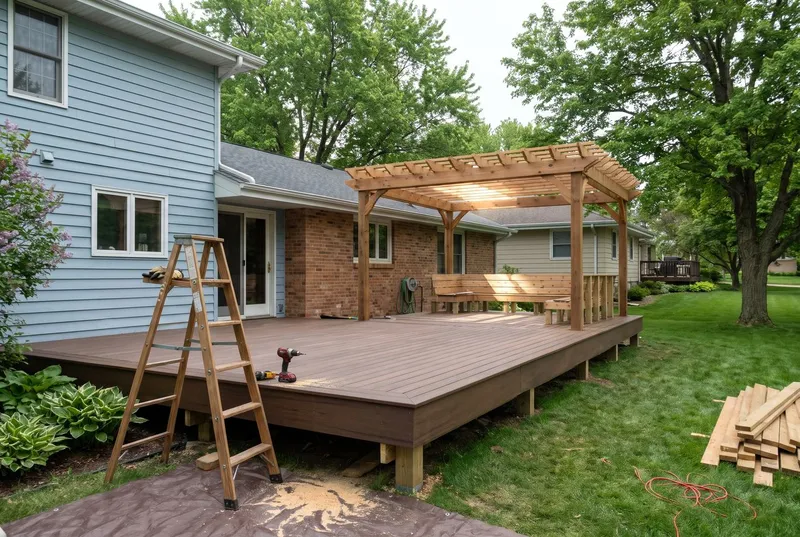
Cedar pergola over a seating corner of a composite deck

Pergolas and shade structures

Cedar and aluminum pergolas tied into the deck frame, or louvered roofs you can close in rain. Posts get their own footings where the load calls for it.

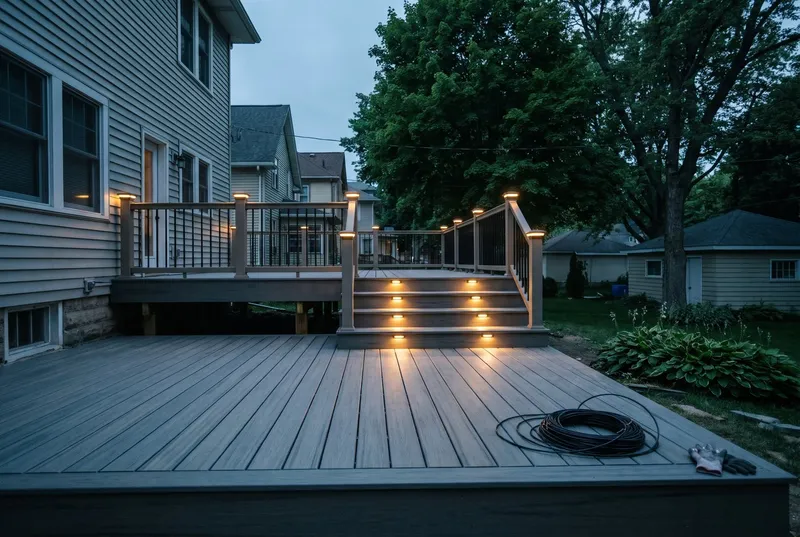
Stair riser and post-cap lights on a composite deck at dusk

Deck lighting

Low-voltage post-cap, stair riser and under-rail lights on one transformer. The wire is run before the boards go down, so none of it shows.

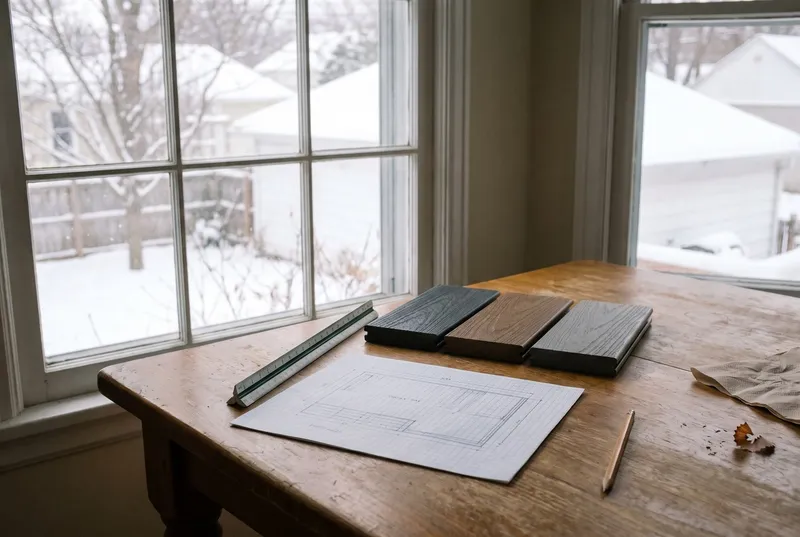
Hand-drawn deck plan and three board samples on a kitchen table in winter

Winter deck design and spring booking

We measure and draw from December to March and get the permit in hand before the thaw. The first build slots open in April and go to decks drawn over winter.

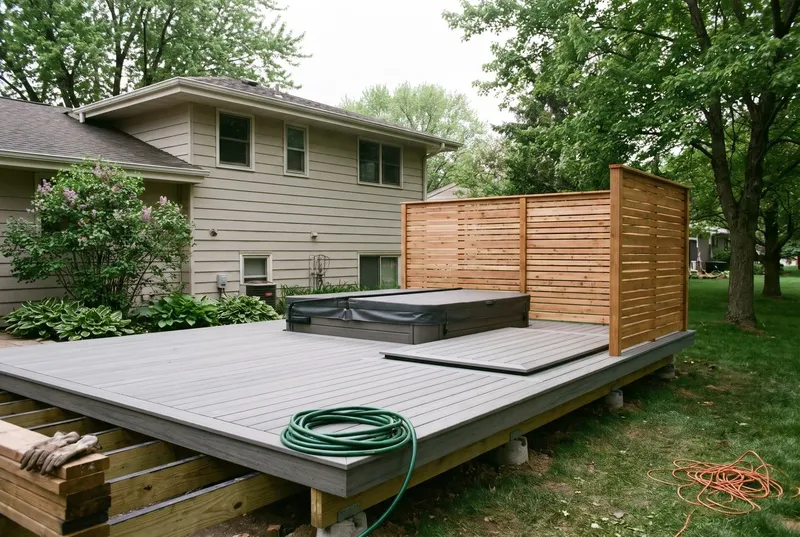
Hot tub set into a composite deck beside a cedar privacy screen

Hot tub and pool decks

Frames built for 100 pounds per square foot under a filled tub, with access panels, slip-resistant boards, and gates and latches around a pool.

Businesses and landlords

Commercial decks in Madison

Restaurant and brewery patios and decks

Raised dining decks with ramps and guards, built with commercial-rated boards. We schedule the work to finish before patio season opens, which in Madison means done by early May.

Rental properties and student housing

Deck, balcony and stair repairs for landlords and property managers, timed between leases. Each job comes with a written condition report and photos for your file.

Condo associations and multi-family

Repeat decks and balconies quoted per unit and phased across a season, with one contact for the board from the first walk-through to the last inspection.

Prices

What a deck costs in Madison

Deck builders price by the project, not by the hour. Size and material set most of the number. Height off the ground, stairs, the railing you pick, tearing out an old deck and the number of footings move it from there.

DeckingInstalled, per sq ftUpkeep
Pressure-treated pine$30 to $45Stain every 2 to 3 years
Cedar$40 to $60Stain every 2 to 3 years
Capped composite$50 to $75Wash once a year
PVC$60 to $90Wash once a year

Area estimates for planning, with standard railing and one set of stairs. Your written quote is the real number.

A 20 by 20 composite deck (400 sq ft)

About $20,000 to $30,000

Capped composite boards, aluminum rail, one stair run, footings to frost depth. A Trex or TimberTech deck of this size lands in the same range; the board line you choose moves it.

A 14 by 20 pressure-treated deck (280 sq ft)

About $8,400 to $12,600

Treated pine frame and boards, wood rail, a few steps to the lawn. Add stain after the lumber has dried.

What the rules ask for here

Building a deck in Wisconsin: footings, railings, permits and winter

Frost is what breaks decks in Dane County. Water in the soil freezes, the ground lifts, and a footing that stops short of the frost line lifts with it. The deck comes back down a little crooked each spring, until the stairs pull away or the ledger tears at the house.

So the hole goes deep. Builders in southern Wisconsin treat 48 inches as the working depth, and the inspector looks at the hole before any concrete goes in. The ledger gets metal flashing over it, because that joint is where snowmelt gets behind the siding first.

An attached deck needs a building permit. In the City of Madison that means a site plan and a framing drawing; Sun Prairie, Fitchburg, Middleton, Verona and Waunakee each run their own office. We prepare the drawings and file them.

QuestionThe ruleWhat it means for your deck
How deep are the footings?Below the frost line. 48 inches is the working depth in southern Wisconsin.Deeper holes and more concrete than a deck down south, and an inspection before the pour.
How high is the railing?A guard at least 36 inches high once the deck is more than 24 inches above the ground.A low deck can go without rail. A walkout deck cannot.
Do I need a permit?Yes for a deck attached to the house. Each city and village issues its own.We prepare the site plan and framing drawing and file them for you.
What does winter do to it?Freeze-thaw lifts shallow footings and works water behind an unflashed ledger.Full-depth footings, metal ledger flashing and joist tape on every build.

Step by step

How a deck build goes, from the first call to the last inspection

  1. Call and rough range

    Tell us the size and the material you have in mind. You get a rough price range on the phone.

  2. Site visit and measure

    We measure the house wall, check the grade and look at how the old deck, if any, is attached.

  3. Drawing and written quote

    A scaled drawing with footings, stairs and rail, plus a written price for the material you chose.

  4. Permit

    We file the site plan and framing drawing with your city or village and wait for approval.

  5. Locate and footings

    Utilities are marked, holes are dug to frost depth and the inspector checks them before concrete.

  6. Framing

    Ledger flashed and bolted, beams and joists set, hangers nailed off. Then the framing inspection.

  7. Decking and rails

    Boards go down with hidden fasteners. Stairs, railings and any lighting follow.

  8. Final inspection and walkthrough

    The inspector signs off, we walk the deck with you and hand over the warranty papers.

Straight answers

Why Madison homeowners call us

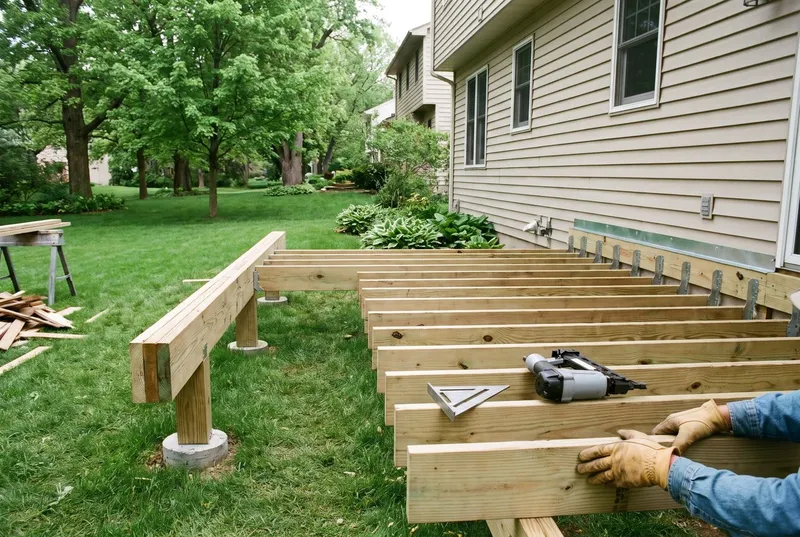
New deck frame with a flashed ledger and joists in galvanized hangers

Materials and brands we build with

Trex, TimberTech, AZEK and Fiberon boards. Western red cedar and ground-contact treated pine. Structural hangers and post bases, coated or stainless screws, joist tape on every frame under composite. Aluminum, cable and glass rail systems. Every board line comes with its maker's warranty, and we hand you the papers at the walkthrough.

Can I build a deck myself?

A ground-level platform is a fair weekend project, and the 3-4-5 triangle will square the frame for you. An attached or raised deck is different. It brings the permit, the ledger connection to the house, four-foot footings and inspections. That is where hiring out pays. If you want to lay the boards yourself, ask us to quote the frame only.

Financing and payment

Financing is available through the contractor for larger projects. Ask when we bring the quote, and we will go over the deposit and payment schedule at the same time.

Trex, TimberTech, AZEK and Fiberon are trademarks of their owners. Product names describe materials commonly installed and do not imply sponsorship.

Typical jobs

Recent deck projects around Madison

Three kinds of job we expect to build most. Sample descriptions until the first finished projects are photographed.

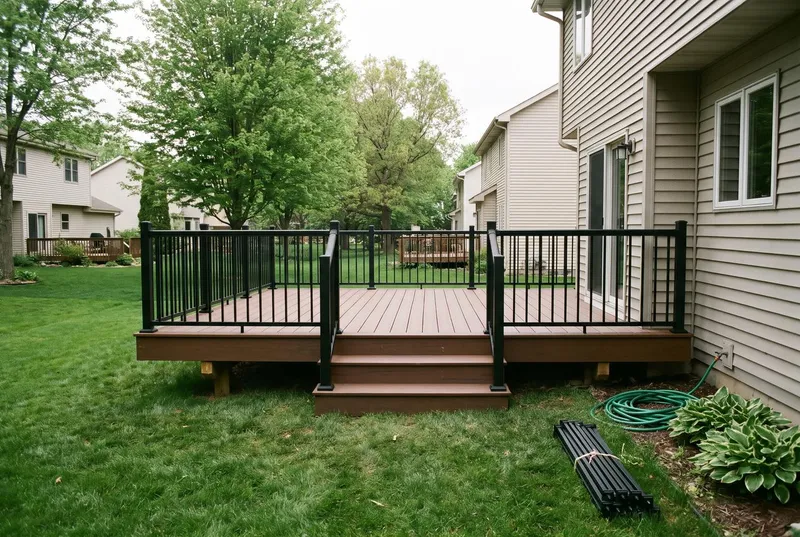
Brown composite deck with black aluminum rail and steps to the lawn

Composite replacement on a 1990s house

A typical job. A worn 12 by 16 treated deck comes out, new footings go to frost depth, and a capped composite deck with aluminum rail goes back in the same spot.

Sample job · composite · about 190 sq ft

Raised composite deck on braced posts with a stair and landing, mid-build

Walkout deck with stairs to the lawn

A typical job. A raised deck off the kitchen of a walkout ranch, on 6x6 posts with diagonal bracing, with a stair and landing down to the yard.

Sample job · composite on treated frame · about 280 sq ft

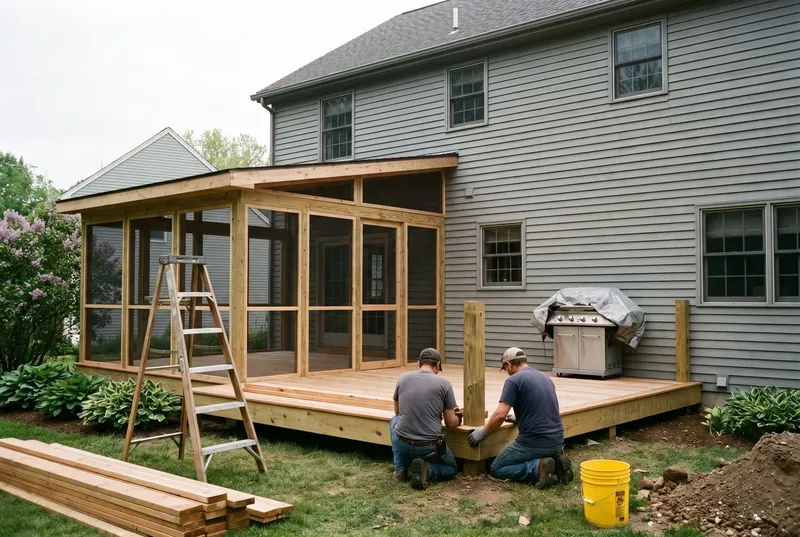
Cedar deck with a screened porch on one half, crew setting the last posts

Cedar deck with a screened porch

A typical job. A cedar deck with one half roofed and screened, so the grill stays outside and the table stays away from the mosquitoes.

Sample job · cedar · about 320 sq ft

See the gallery

Where we build

Serving Madison and Dane County

We build and repair decks across Madison and the towns around it. Each town issues its own permit, and we file with the right office for your address.

  • Madison
  • Sun Prairie
  • Fitchburg
  • Middleton
  • Verona
  • Waunakee
  • McFarland
  • Monona
  • Stoughton
  • Oregon
  • DeForest
  • Cottage Grove

Questions

Deck Builder FAQ

How much does a 20x20 deck cost in Madison?

A 400 square foot composite deck usually runs about $20,000 to $30,000 with rail and stairs. The same deck in pressure-treated pine is roughly $12,000 to $18,000.

Is a composite deck worth the money in Wisconsin?

For most people who plan to stay, yes. It costs more up front, but you skip staining every two or three years and the boards do not rot.

How deep do deck footings need to be here?

Below the frost line. In the Madison area that means holes about 48 inches deep, checked by the inspector before concrete.

How high does a deck railing have to be?

At least 36 inches, on any deck more than 24 inches above the ground. Lower decks can go without a guard.

Do I need a permit to build a deck in Madison?

Yes, for a deck attached to the house. We prepare the drawings and file with Madison or your own city or village.

When is the best time of year to build?

April through November. Draw and price it over winter, and your deck is among the first built when the ground thaws.

How long does a deck take to build?

One to two weeks for most decks once the permit is in hand. A screened porch or three season room takes three to five.

Can my old deck be repaired, or does it need replacing?

If the footings and most of the frame are sound, repair it. When more than a third of the frame is soft, replacing costs less over time.

Can you put composite boards on my existing frame?

Often, yes. The frame has to pass inspection, and composite may need extra blocking or closer joists.

Cedar or pressure-treated, which lasts longer?

Treated pine resists rot longer in the frame. Cedar looks better on top and stays flatter. Many decks use both.

How often does a wood deck need staining?

Every two to three years in Wisconsin, sooner on boards that face south or sit under trees.

Do you offer financing?

Financing is available through the contractor for larger projects. Ask when we bring the quote.

Which towns do you serve?

Madison, Sun Prairie, Fitchburg, Middleton, Verona, Waunakee, McFarland, Monona, Stoughton, Oregon, DeForest and Cottage Grove.
Free written quote

Tell us about your deck

(608) 555-0100

Call, or send the form and we will ring you back to set a time to measure. Photos of the yard or the old deck help.

Talk to a deck builder

Request a quote

The measure, the drawing and the written quote are free.

Call (608) 555-0100nowFree quote